The Legend: The Great Race of the Zodiac Animals
The Jade Emperor’s Decision
According to Chinese Mythology, the Jade Emperor, wanted to find a way to measure time.
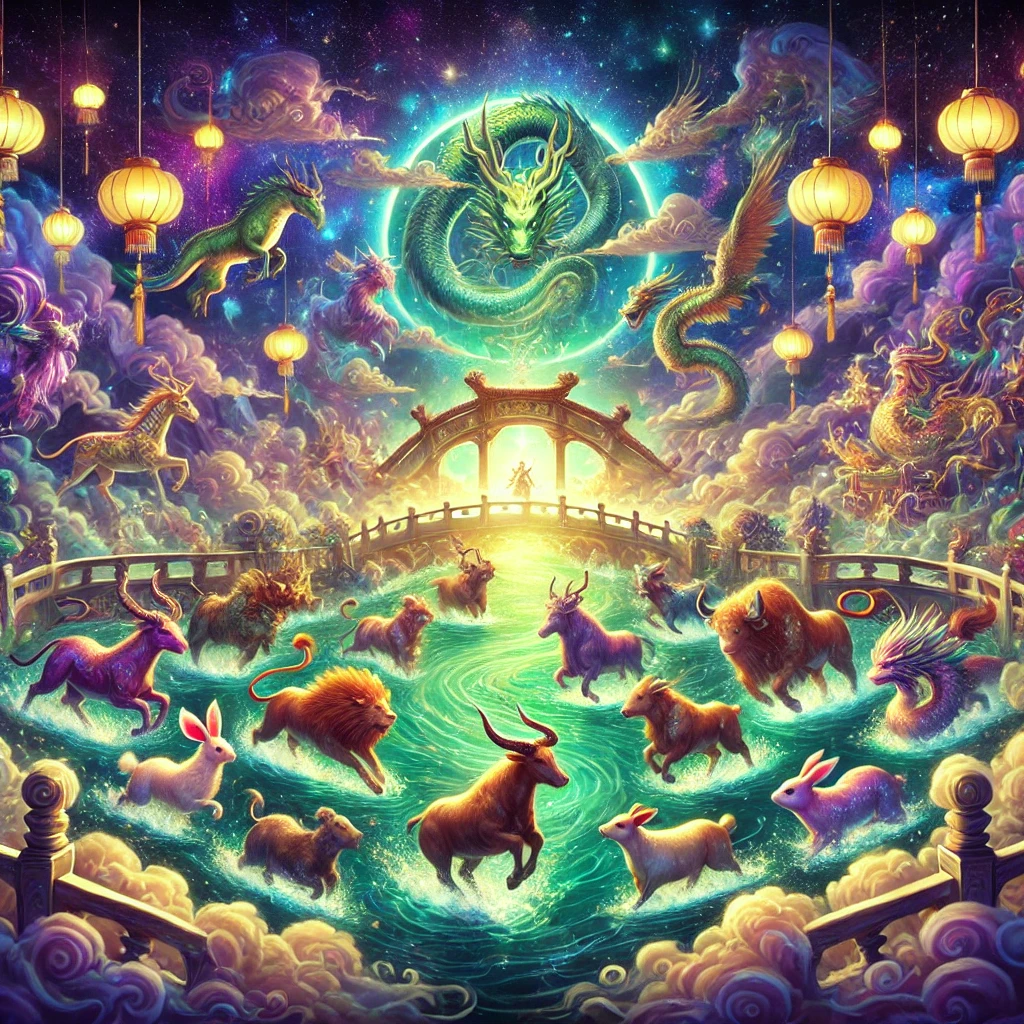
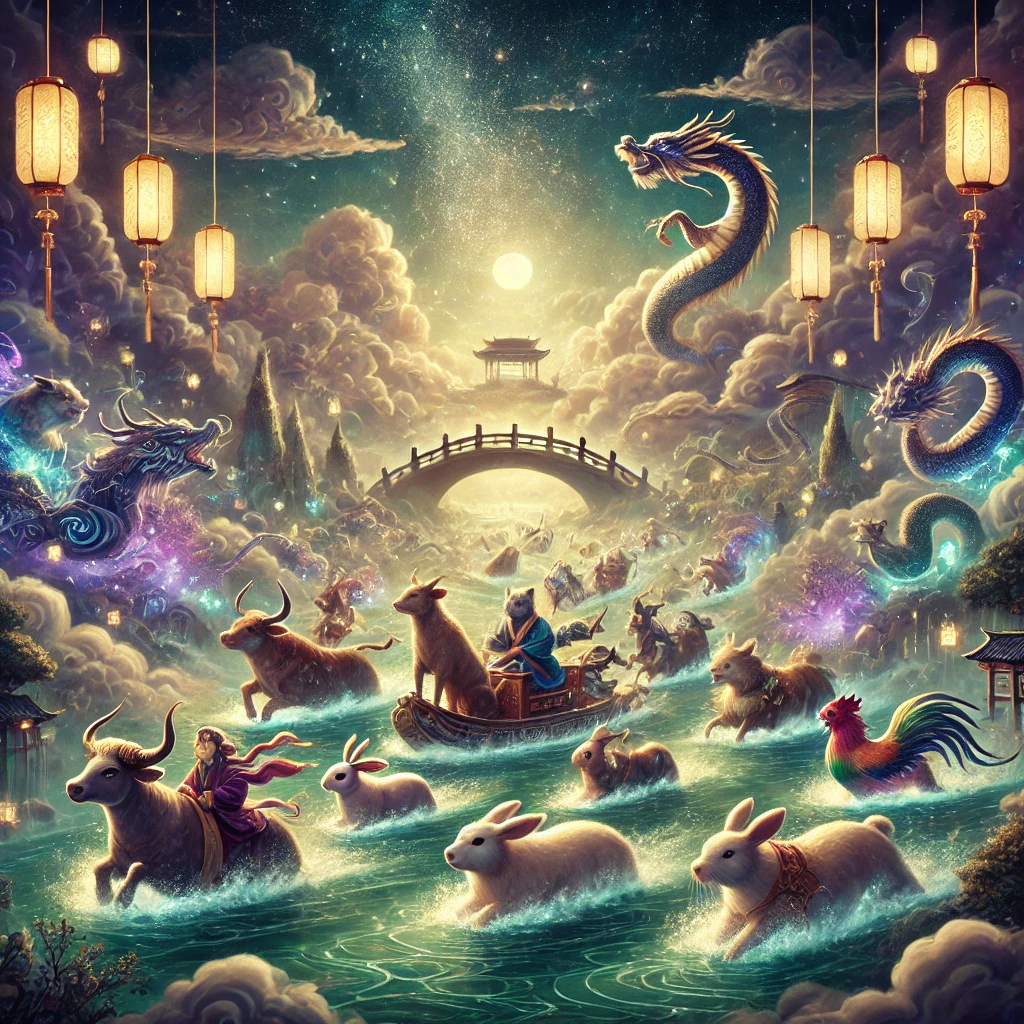
He decided to organize a great race and invited all the animals to participate. The first 12 animals to cross the river and reach the finish line would have a year named after them, determining the order of the Chinese Zodiac.
The Race Begins
Many animals showed up for the challenge, but only 12 would succeed.
Here is how the race unfolded:
– The Rat: Clever and resourceful, the rat hopped onto the Ox’s back and jumped ahead at the last moment, securing 1st place.
– The Ox: Hardworking and diligent, the Ox finished in 2nd place.
– The Tiger: Strong and powerful, the tiger struggled against the river’s current but managed to finish 3rd.
– The Rabbit: Quick and nimble, the rabbit used stepping stones and a floating log to reach 4th place.
– The Dragon: The kind-hearted dragon stopped to help others and arrived 5th.
– The Snake: Cunning, the snake hid in the horse’s mane and slithered ahead at the last moment, taking 6th place.
– The Horse: Startled by the snake, the horse came in 7th.
– The Goat: Gentle and cooperative, the goat arrived 8th after working with the monkey and the rooster.
– The Monkey: Clever and agile, the monkey finished 9th.
– The Rooster: Diligent and strategic, the rooster took 10th place.
– The Dog: Distracted by the water, the dog arrived 11th.
– The Pig: Slow and steady, the pig stopped for a snack and a nap before finally finishing in 12th place.
The Aftermath
The Jade Emperor honored each of these animals by naming a year after them in the order they finished. Since then, the Chinese zodiac cycle has followed this sequence, repeating every 12 years.
Historical and Cultural Context: The Jade Emperor in Chinese Mythology
The Jade Emperor (Yù Huáng, 玉皇) is a major deity in Taoism and Chinese folklore. Considered the ruler of Heaven, he oversees divinities, spirits, and mortals.
The story of the zodiac aligns with his role as a celestial administrator, reflecting ancient Chinese beliefs about order, hierarchy, and cosmic balance.
Ancient China and Timekeeping
The Chinese zodiac system dates back more than 2000 years to the Han Dynasty (206 BCE–220 CE). The 12-year cycle aligns with the traditional lunar calendar, which was used for agriculture, governance, and daily life.
Each zodiac animal represents different personality traits and is associated with elements, directions, and compatibility charts.
Cultural and Folklore Evolution
Influence on Personality and Destiny
In Chinese culture, a person’s zodiac sign is believed to influence their personality, fortune, and compatibility with others.
For example:
– Rats are considered intelligent and resourceful.
– Dragons are powerful and charismatic.
– Pigs are generous and easygoing.
Zodiac in Chinese Traditions
The Chinese zodiac plays a major role in:
– New Year celebrations: Each year is dedicated to an animal, bringing unique festivities and customs.
– Marriage and compatibility: Many families consult zodiac charts to determine harmonious relationships.
Business and fortune-telling: Zodiac predictions guide career choices and major life decisions.
Expansion Beyond China
With the spread of Chinese culture, the zodiac became popular in countries like Japan, Korea, Vietnam, and Thailand, each with slight variations.
The Chinese Zodiac in Modern Times
Pop Culture and Media
The Chinese zodiac has been featured in films, books, and TV shows worldwide.
Commercial Influence
Luxury brands and major corporations incorporate zodiac-themed marketing campaigns during Chinese New Year, launching limited-edition products based on the year’s animal.
Relevance Today
Despite modernization, the zodiac remains deeply embedded in Chinese culture. People still check their horoscope for career guidance, relationship advice, and luck predictions.
One last word
The legend of The Jade Emperor and the Great Zodiac Race is a captivating tale that continues to shape Chinese culture and beyond.
Whether in traditional celebrations, personal beliefs, or modern entertainment, the Chinese zodiac remains a timeless symbol of heritage and identity.