🦋 Itzpapalotl: The Obsidian Butterfly Who Ruled the Realm of Fallen Warriors
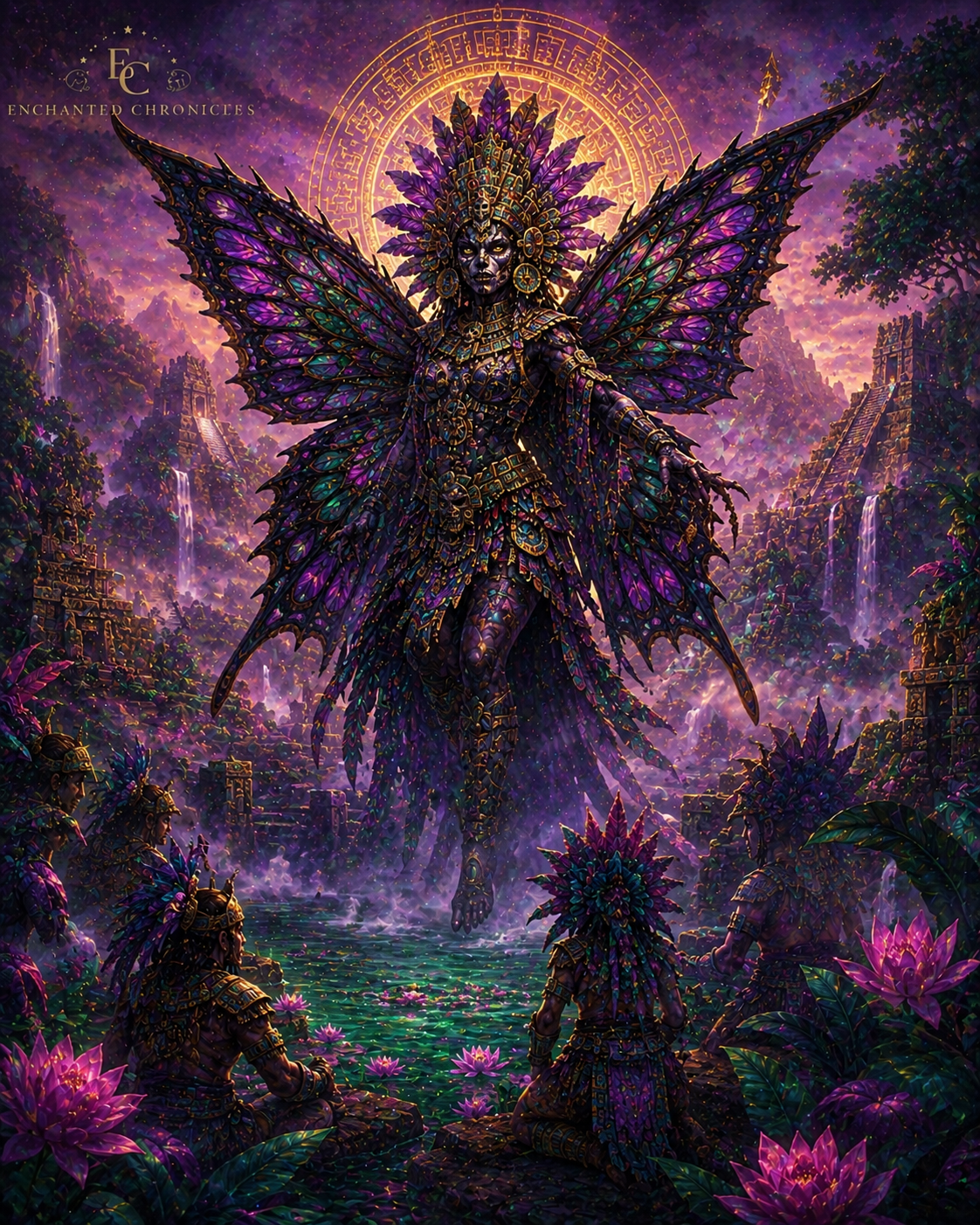
In the heart of Central Mexico, there was a being so beautiful that she inspired awe… and so terrifying that warriors trembled at the sound of her wings. She descended from the clouds draped in obsidian blades and butterfly shadows, reigning over a paradise reserved for spirits lost in battle. Her name was Itzpapalotl — the Obsidian Butterfly — one of the most haunting and forgotten figures of Mesoamerican mythology.
Lirien Thornveil
Folklore Researcher & Mythology Writer
🦋 The Meaning Behind the Obsidian Butterfly
To understand Itzpapalotl, one must understand the symbolism of butterflies in ancient Mesoamerica.
Butterflies were not simply delicate creatures.
They represented:
- Spirits of the dead
- Transformation
- Fire
- Spiritual rebirth
- The passage between worlds
Warriors killed in battle were sometimes believed to return as butterflies or hummingbirds, drinking nectar beneath the sun before continuing their cosmic journey.
But Itzpapalotl embodied the darker side of transformation.
Her wings were not soft.
They were obsidian.
Sharp volcanic glass associated with ritual sacrifice, warfare, and sacred power.
She represented beauty sharpened into danger.
⚔️ The Paradise of Warrior Spirits
Itzpapalotl is most closely linked to Tamoanchan — a mythical paradise overflowing with flowers, celestial light, sacred trees, and eternal abundance.
Yet beneath this beauty lingered violence and sacrifice.
Ancient traditions describe Itzpapalotl as a ruler or powerful presence within this realm, particularly connected to spirits transformed through suffering and battle.
This duality made her deeply fascinating:
- nurturing yet destructive
- radiant yet terrifying
- protective yet predatory
Unlike simplified modern fantasy archetypes, she could not be reduced to “good” or “evil.”
She existed beyond those categories.
🌌 The Celestial Hunter of the Night
Some myths portray Itzpapalotl as a fearsome night being associated with the Tzitzimimeh — celestial entities linked to darkness, eclipses, and cosmic destruction.
According to Aztec belief, during moments when cosmic balance weakened, these terrifying beings could descend from the clouds to consume humanity.
Itzpapalotl stood among the most feared.
Ancient codices depict her with:
- skeletal limbs
- clawed feet
- obsidian-tipped wings
- eagle and jaguar features
- butterfly symbolism intertwined with death imagery
Her visual identity is so striking that even today she feels almost modern — like something born from dark fantasy art rather than ancient oral tradition.
And yet her origins are centuries old.
🔥 The Warrior Mother and Protector
Despite her terrifying nature, Itzpapalotl was also connected to ancestry and protection.
Certain traditions portray her as a maternal figure tied to the origins of nomadic peoples. She guided and protected chosen warriors while also testing them through suffering.
This contradiction is central to her power.
In ancient Mesoamerican thought:
- destruction created renewal
- sacrifice sustained existence
- fear and beauty often walked together
Itzpapalotl embodied all of it at once.
🌎 Why This Legend Is Being Rediscovered Today
For centuries, figures like Quetzalcoatl dominated popular discussions of Aztec mythology.
But recently, Itzpapalotl has begun re-emerging online because she possesses something incredibly rare:
A visual and emotional identity unlike almost any mythological figure in world folklore.
She resonates deeply with:
- dark fantasy audiences
- gothic aesthetics
- symbolism enthusiasts
- mythology lovers
- fans of feminine cosmic archetypes
And yet most people still have never heard her name.
That makes her one of the greatest forgotten mythic figures on the Internet today.
🌙 Why Itzpapalotl Still Fascinates Modern Audiences
Itzpapalotl survives because she represents contradictions modern audiences find irresistible:
- Beauty fused with danger
- Femininity fused with power
- Transformation fused with violence
- Death fused with transcendence
She is not passive mythology.
She feels alive.
Like something waiting beneath the surface of memory.
📚 Historical Sources & Authenticity
Itzpapalotl appears in several authentic Mesoamerican sources and traditions, including:
- Codex Borgia
- Codex Vaticanus
- Aztec cosmological traditions
- Chichimec oral narratives
- Colonial-era accounts documenting pre-Hispanic beliefs
Scholars of Mesoamerican religion recognize her as an important but often overlooked figure connected to warrior spirituality, celestial mythology, and transformation symbolism.
This is not a modern invention.
It is a real fragment of ancient memory.
❄️ FAQ –Itzpapalotl Explained
Who is Itzpapalotl?
Itzpapalotl is a powerful figure from Aztec mythology known as the “Obsidian Butterfly,” associated with warrior spirits, transformation, sacrifice, and celestial darkness.
What does Itzpapalotl mean?
The name Itzpapalotl translates roughly to “Obsidian Butterfly” in Nahuatl.
Why do the Menehune only work at night?
Folklore says they hide in old houses, abandoned buildings, or underground places, especially in rural villages.
Why is Itzpapalotl associated with butterflies?
In Mesoamerican symbolism, butterflies represented souls, transformation, fire, and rebirth — especially the spirits of fallen warriors.
Would you like to discover other Realms…. Come this way…
Join our community of readers register for our newsletter!