Xolotl: The Dog-Headed Divinity Who Guided Souls Through the Aztec Underworld
Discover the haunting legend of Xolotl, the dog-headed Aztec divinity who guided souls through the Underworld. Explore his origins, symbolism, mythology, and enduring legacy in Mesoamerican culture.
Lirien Thornveil
Folklore Researcher & Mythology Writer
🌿 The Origins of Xolotl
The origins of Xolotl emerge from the vast cosmology of Aztec mythology, a world where divinities sacrificed themselves repeatedly to keep existence alive.
Xolotl was believed to be the twin brother of Quetzalcoatl, the Feathered Serpent — one of the most revered deities in Mesoamerican belief. While Quetzalcoatl represented light, knowledge, wind, and civilization, Xolotl embodied the darker reflection of those forces.
Where one brought life, the other guided death.
Where one rose with the morning star, the other followed as the evening star fading into night.
This duality was central to Aztec thought. The universe depended on balance: life and death, fire and darkness, sacrifice and rebirth.
Xolotl existed in the spaces people feared most — caves, shadows, storms, and the silent roads traveled by the dead.
🌙 The Dog-Headed Divinity of the Underworld
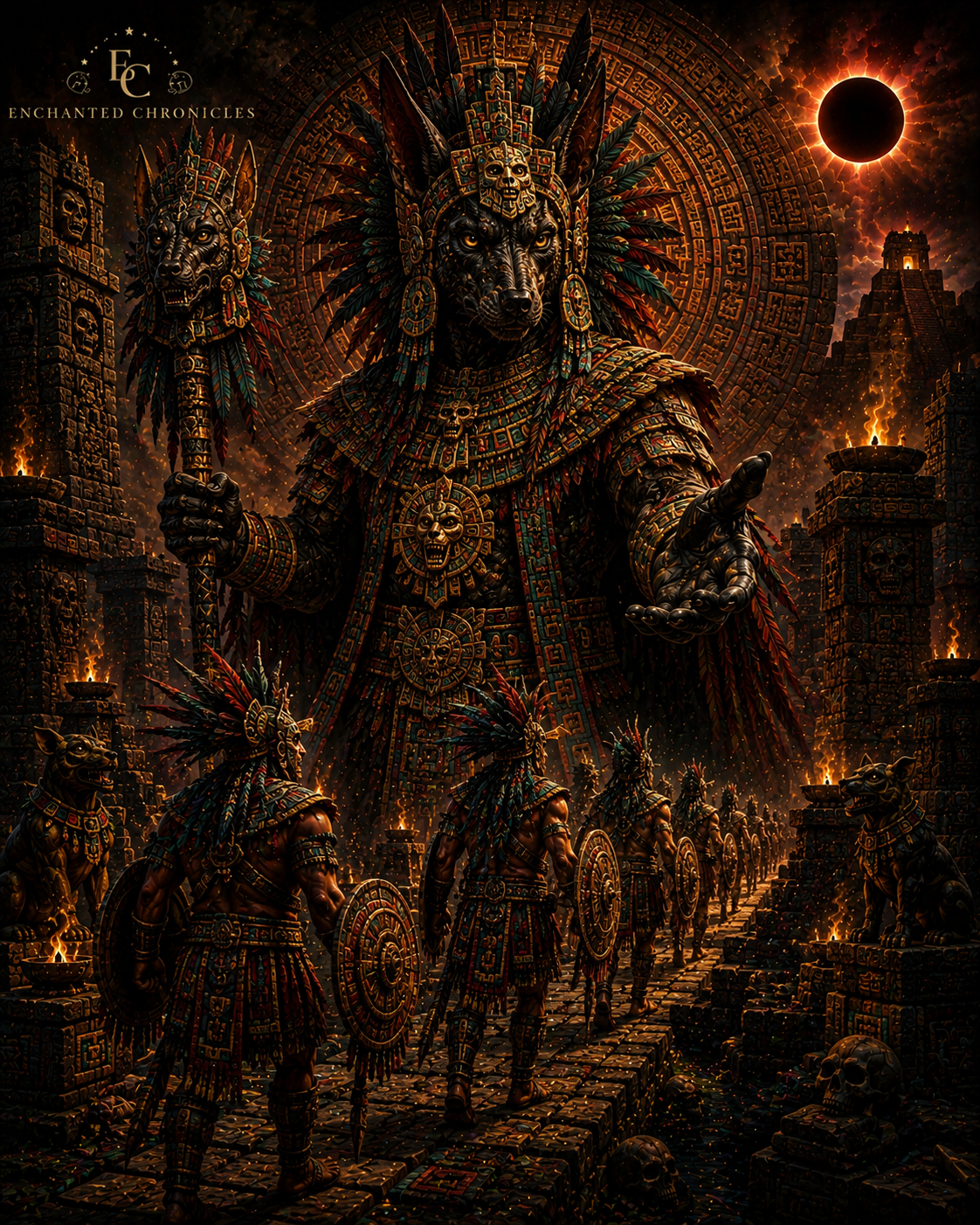
Ancient codices often depict Xolotl with the head of a dog, reversed feet, skeletal features, or twisted limbs. To modern eyes, these images may seem grotesque, but to the Aztecs they carried profound symbolic meaning.
Dogs were sacred guides.
The Aztecs believed that after death, a soul had to cross dangerous rivers and survive countless trials before reaching Mictlan, the deepest realm of the dead. Ordinary humans could not complete this passage alone.
Only a dog could lead them.
This belief is strongly connected to the Xoloitzcuintli, the ancient hairless dog native to Mexico. Many Aztecs buried these dogs beside the dead so they could guide their owners safely through the afterlife.
Xolotl became the divine embodiment of this sacred companion.
He was feared, yes — but he was also necessary.
Without him, souls would wander forever in darkness.
🌺 Xolotl and the Creation of Humanity
One of the most fascinating Aztec myths tells how Xolotl helped create humanity itself.
After the destruction of earlier worlds, the divinities decided a new age of humans had to be born. Quetzalcoatl descended into Mictlan to retrieve the bones of previous generations, but the journey was perilous.
Xolotl accompanied him.
Together, they entered the realm of death ruled by Mictlantecuhtli, the lord of the underworld. Through deception, sacrifice, and divine struggle, the sacred bones were recovered.
The divinities then spilled their own blood upon the bones.
Humanity was reborn.
This story reveals something extraordinary about Xolotl: despite his terrifying appearance and association with death, he was also tied directly to creation and renewal.
Death and life were never separate in Aztec cosmology.
One fed the other endlessly.
🌊 The Aztec Divinity Who Tried to Escape Sacrifice
Perhaps the most tragic legend surrounding Xolotl concerns the creation of the Fifth Sun — the current age of the world according to Aztec belief.
The divinities gathered to sacrifice themselves so the sun could move across the sky and restore life to the universe.
But Xolotl was afraid.
Unlike the other divinities, he resisted death.
Terrified, he fled and transformed himself repeatedly to escape sacrifice. Some myths say he became a stalk of maize, then a maguey plant, and finally an axolotl — the strange aquatic salamander whose name may derive from him.
Yet escape was impossible.
Eventually Xolotl was captured and sacrificed like the others.
The myth is deeply human. Even a divinity feared annihilation.
And perhaps that is why Xolotl remains one of the most emotionally compelling figures in all of Mesoamerican mythology.
🐾 The Meaning Behind Xolotl
Xolotl represented far more than death.
He symbolized:
- Transformation
- Fear of mortality
- Sacrifice
- Duality
- The unknown
- Guidance through darkness
Unlike purely evil underworld figures found in later traditions, Xolotl occupied a morally complex role. He was terrifying, but compassionate. Frightening, yet protective.
He escorted souls not to punish them, but to help them complete the final passage every human must one day face.
That nuance gives the legend remarkable emotional depth even today.
🌙 Xolotl in Modern Culture
The legacy of Xolotl still survives across Mexico and beyond.
The Xoloitzcuintli dog remains one of the oldest dog breeds in the Americas and continues to symbolize spiritual protection and ancestral connection.
Meanwhile, Xolotl himself appears in:
- Literature
- Video games
- Fantasy art
- Horror fiction
- Academic studies of Mesoamerican religion
- Modern Mexican cultural symbolism
Interest in Aztec mythology has surged online in recent years, and Xolotl stands out because of his unique visual identity and psychological complexity.
He is not simply a monster.
He is the companion waiting at the edge of darkness.
🔍 Why the Legend of Xolotl Still Fascinates the World
Some myths survive because they inspire hope.
Others survive because they reveal uncomfortable truths.
Xolotl endures because he embodies both.
He reminds us that death is mysterious, frightening, and unavoidable — but also that no soul walks into darkness alone.
Across centuries, from ancient temples to modern digital art, the dog-headed divinity continues to stare out from the shadows of history.
Not as a destroyer.
But as a guide.
❄️ FAQ –The Xolotl Explained
Who was Xolotl in Aztec mythology?
Xolotl was an Aztec divinity associated with death, lightning, fire, transformation, and the underworld. He was believed to guide souls through Mictlan after death.
Why is Xolotl depicted with a dog head?
Dogs were sacred spiritual guides in Aztec belief. Xolotl’s dog-like appearance symbolized his role as protector and escort of the dead.
Is Xolotl evil?
No. Although associated with death and darkness, Xolotl was not considered evil. He played a necessary role in guiding souls and maintaining cosmic balance.
Did Xolotl create humans?
According to Aztec mythology, Xolotl helped Quetzalcoatl retrieve ancient bones from the underworld, which were then used to create humanity.
Would you like to discover other Realms…. Come this way…
Join our community of readers register for our newsletter!