A Pre-Hispanic Legend That Still Haunts the Hills of Tlaxcala (Mexico)
In the small, volcanic valleys of Tlaxcala in Mexico, a legend older than the Spanish conquest still survives—whispered at kitchens, recounted in Nahuatl, and documented by anthropologists who were astonished by the persistence of a pre-Hispanic belief.
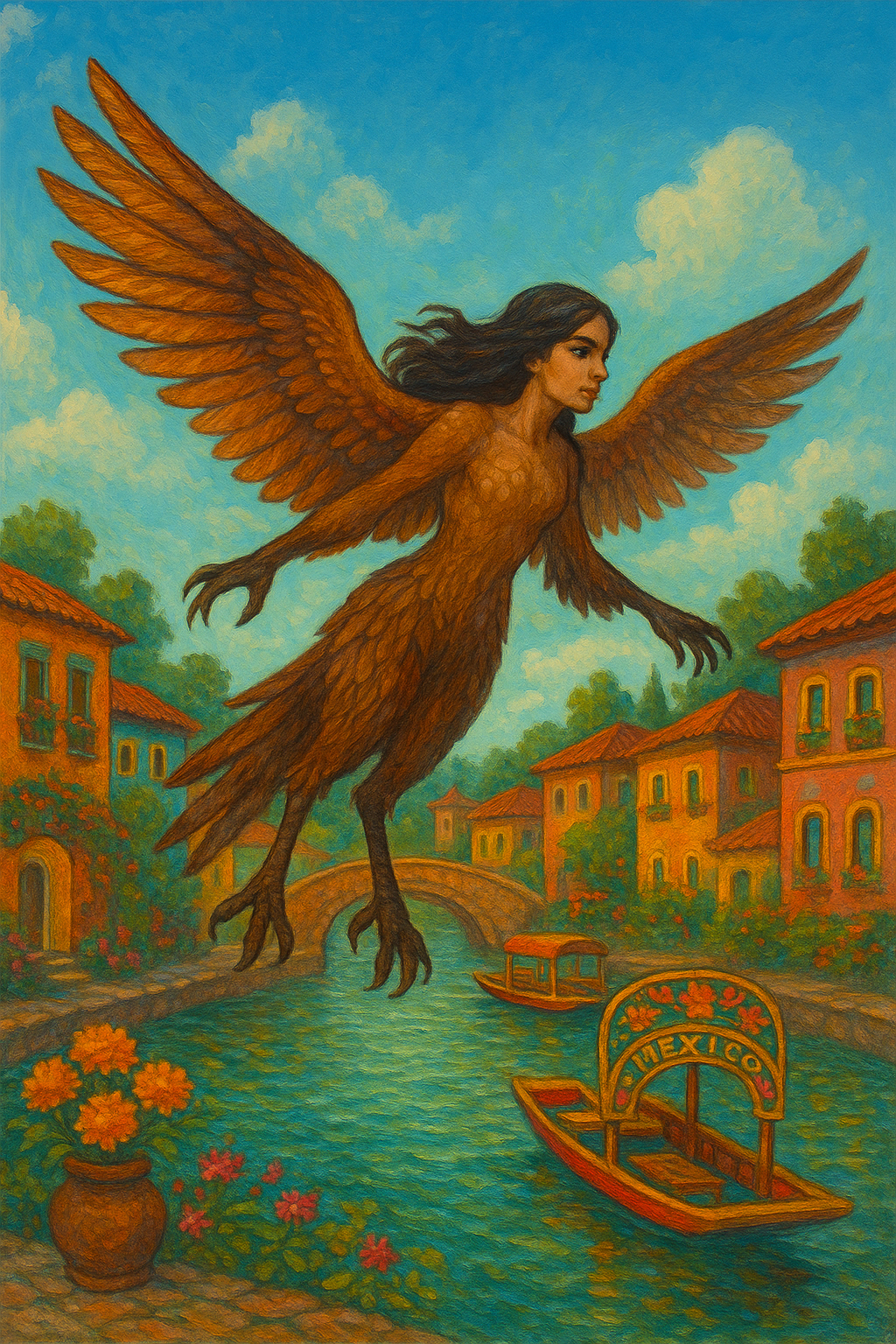
The Tlahuelpuchi, a nocturnal shapeshifter believed to be a woman with the inherited ability to transform into a winged creature, remains one of the most fascinating examples of living Mexican folklore.
Part owl, part shadow, part flame blazing across the sky, this myth continues to captivate the popular imagination—and confuse those who wish to separate myth from anthropology.
Origins: A Legend Rooted in Pre-Hispanic Cosmology
Long before colonial friars documented the region, Nahua-speaking communities in present-day Tlaxcala held complex beliefs about tonalli, the animating force that could take animal form.
The Tlahuelpuchi belongs to this worldview—women born with a dormant power that awakens in adolescence. According to tradition, the ability is not chosen but inherited, a burden passed silently through certain family lines.
By night, she leaves her human body behind and turns into a creature that can glide above villages, fields, and ravines.
While some stories describe her as a giant bird, others evoke a fiery orb or a spectral figure with elongated wings.
What remains constant is the atmosphere: shadows, night air, and a cry carried by the wind.
The Spanish attempted to suppress belief in shapeshifters, branding them as witches. Yet the concept survived, merging pre-Hispanic cosmology with colonial fears of nocturnal sorcery.
This blending of old and new is precisely what makes the Tlahuelpuchi such an enduring figure.
Documented Anthropology: A Rare Case of Living Mythology
In the 20th century, the Tlahuelpuchi became a subject of formal anthropological research.
Studies published in the Revista Mexicana de Estudios Antropológicos, documented interviews with families, midwives, and elders who described the phenomenon in detail.
The INAH (Instituto Nacional de Antropología e Historia) in Tlaxcala also includes oral accounts collected through its cultural heritage programs.
Rather than fading, the legend adapted to modernization. In many Tlaxcalan towns, parents still warn children not to wander at dusk, and some older residents claim to have seen a “firebird” cutting through the night sky.
From Myth to Folklore: How the Legend Lives Today
Today, the Tlahuelpuchi occupies a fascinating paradoxical space: she is feared, respected, and increasingly reinterpreted through culture, art, and storytelling. Rather than fading into obscurity, the legend continues to evolve — shaped by memory, imagination, and the enduring human fascination with the unknown.
More than a relic of the past, she has become a living symbol of how ancient beliefs adapt to modern identity, blending superstition, cultural heritage, and contemporary curiosity.
Local Identity
In rural regions of Tlaxcala, the Tlahuelpuchi is rarely dismissed as mere fiction. For some communities, she represents the mysteries of the night — the unseen forces that coexist with everyday life. Stories told by elders still carry emotional weight, functioning less as literal warnings and more as cultural reflections on secrecy, vulnerability, and the limits of human understanding.
This belief system historically served practical purposes as well: reinforcing community vigilance, explaining unexplained illness or loss, and preserving social cohesion through shared narratives. Even today, the legend quietly shapes local identity, folklore celebrations, and oral traditions passed from one generation to the next.
National Folklore
Across Mexico, the Tlahuelpuchi has transcended regional storytelling to become a broader folkloric figure. Horror cinema, graphic novels, podcasts, and digital storytelling have reimagined her — sometimes as a terrifying predator, other times as a tragic or misunderstood figure.
Unlike European werewolves or Slavic night spirits, her mythology is deeply rooted in indigenous cosmology, colonial history, and uniquely Mexican views on transformation, femininity, and the supernatural. This distinct origin keeps her legend culturally anchored while allowing creative reinterpretations that attract younger audiences.
As a result, this folkloric mexican figure now lives simultaneously in tradition and popular culture — an ancient myth continually rewritten.
International Curiosity
Beyond Mexico, the legend increasingly draws attention from anthropologists, folklorists, historians, and speculative fiction enthusiasts. Scholars examine it as a window into indigenous belief systems, colonial anxieties, and the symbolic role of female supernatural figures.
Writers and artists, meanwhile, are captivated by the imagery: a woman who transforms into a fiery, winged entity navigating darkness between worlds. This powerful symbolism resonates globally, touching universal themes of transformation, fear, identity, and the unknown.
Through documentaries, academic research, fantasy literature, and online folklore communities, this figure has begun to take her place among the world’s most intriguing mythological figures.
Why the story Still Captivates Us
More than a monster, she embodies timeless human questions:
– What do we fear when the lights go out?
– How do cultures explain the unexplainable?
– Why are transformation myths so persistent across civilizations?
And what happens when folklore becomes part of collective identity rather than simple superstition?
The Tlahuelpuchi fascinates because she sits at the intersection of myth, psychology, culture, and mystery. She reminds us that legends are rarely just stories — they are mirrors reflecting human fears, hopes, and the enduring need to make sense of the unseen.
And perhaps that is why her legend endures: not because people believe literally, but because they recognize something emotionally true within it.