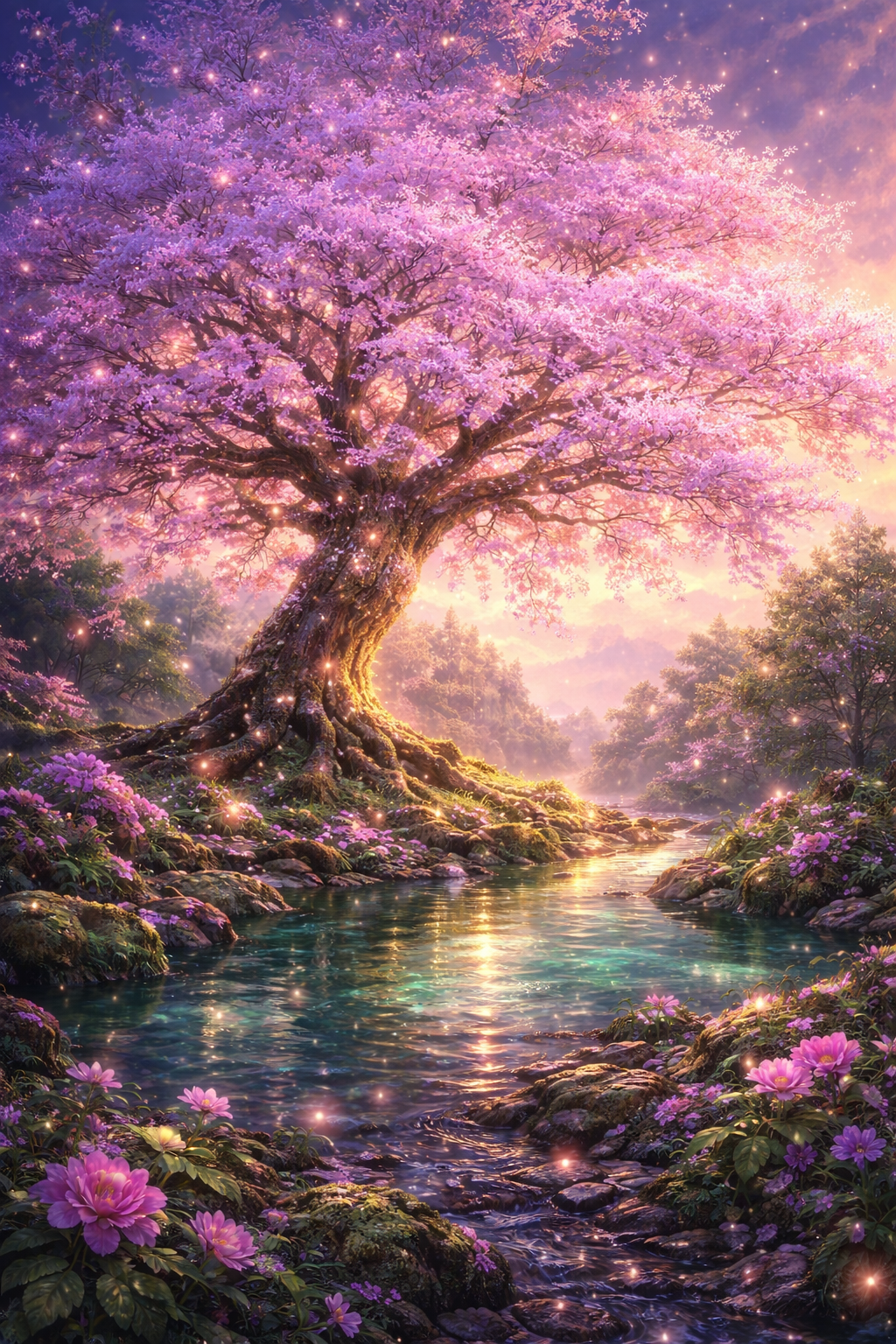
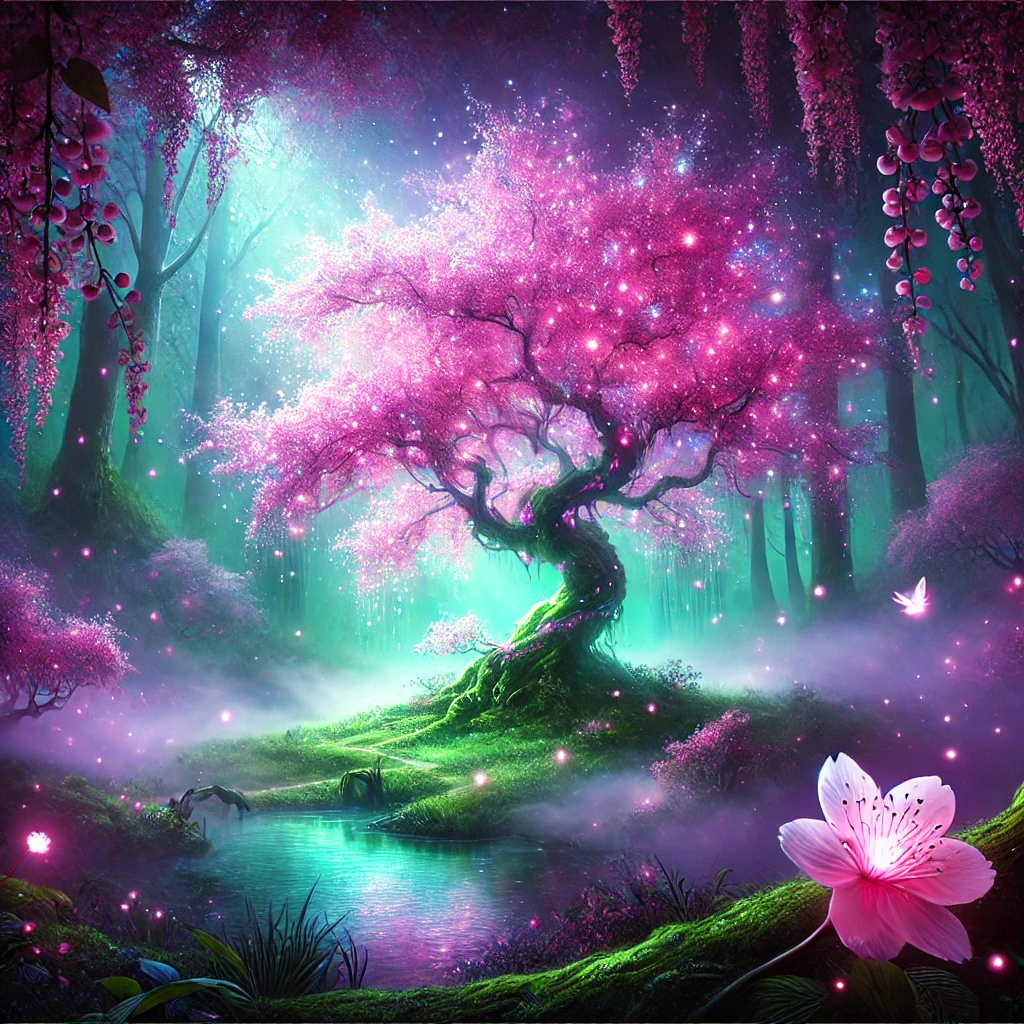
Who is Konohanasakuya-hime?
Before emperors ruled from palaces of wood and gold, before poets wrote of falling petals, the mountains of Japan were believed to breathe with divine life.
In the oldest chronicles of the archipelago, nature was not scenery — it was sacred presence. Peaks were divinities. Rivers carried spirit. Blossoms were signs from the heavens.
Among these divine forces emerged one of the most luminous figures of Japanese mythology: Konohanasakuya-hime, the Blossom Princess.
Her story, preserved in Japan’s earliest texts, would shape the spiritual meaning of the cherry blossom for centuries to come
The Origins of the Legend
The story of Konohanasakuya-hime appears in Japan’s two foundational chronicles:
– Kojiki (712 CE)
– Nihon Shoki (720 CE)
These texts recount the creation of Japan, the genealogy of the kami (divinities), and the descent of heavenly beings to earth.
Within these sacred narratives, Konohanasakuya-hime is introduced as a radiant goddess associated with flowering trees, fertility, and the sacred mountains — particularly Mount Fuji.
Her name can be translated as: “She Who Makes the Tree Blossoms Flourish.”
In early Shinto cosmology, trees were not decorative elements of nature. They were living vessels of divine essence.
Blossoming trees marked the presence of spiritual vitality. Through Konohanasakuya-hime, flowering became sacred.
Symbolism Behind the Myth
According to the chronicles, Konohanasakuya-hime was the daughter of the mountain deity Ōyamatsumi-no-Kami.
She encountered Ninigi-no-Mikoto, the grandson of the sun goddess Amaterasu, when he descended from the heavens to rule the earth.
Struck by her beauty, Ninigi asked for her hand in marriage.
Her father agreed — but offered both daughters:
– Konohanasakuya-hime (the blossoming princess)
– Iwanaga-hime (the princess of rock and stone)
Ninigi chose only Konohanasakuya-hime and rejected Iwanaga-hime.
This choice carried profound symbolic consequences.
Iwanaga-hime represented endurance and eternal stability — like stone.
Konohanasakuya-hime represented beauty, vitality, and flowering — but also impermanence.
Because Ninigi rejected the stone princess, it is said that human life became fleeting like blossoms rather than enduring like rock.
Here lies one of the deepest symbolic foundations of Japanese thought.
The trial by fire
Soon after their marriage, Konohanasakuya-hime became pregnant.
Ninigi doubted that the child was truly his, suspecting earthly origin rather than divine descent.
In response, the goddess made a solemn declaration:
If the child were truly of heavenly lineage, neither she nor the baby would perish in flames.
She sealed herself inside a childbirth hut and set it ablaze.
The structure burned fiercely.
Yet from within the flames, she gave birth safely to three sons.
Both mother and children survived unharmed.
This episode, recorded in the earliest chronicles, established her as:
– A goddess of fertility
– A guardian of safe childbirth
– A symbol of purity proven through ordeal
– A divine force of renewal emerging from destruction
The image of life born within fire echoes through centuries of Japanese spiritual symbolism.
The Sacred Mountains and Mount Fuji
Konohanasakuya-hime became closely associated with Mount Fuji, Japan’s most iconic and sacred mountain.
Shrines dedicated to her — known as Sengen Shrines — were built around the base and slopes of Fuji.
Pilgrims prayed to her for:
– Protection from volcanic eruptions
– Safe childbirth
– Fertility and family well-being
– Agricultural prosperity
In this way, her myth moved beyond text into living ritual.
Even today, Fujisan Hongū Sengen Taisha remains one of the central shrines honoring her.
Through her, the mountain itself became a symbol of spiritual beauty — powerful yet transient, majestic yet vulnerable.
The Meaning of the Sakura
Although the ancient chronicles do not describe a specific “eternal sakura tree,” later cultural tradition deeply connected Konohanasakuya-hime with cherry blossoms.
Over centuries, the sakura came to embody a uniquely Japanese aesthetic concept: mono no aware
This phrase expresses a gentle sadness — the awareness that all beauty is fleeting.
Cherry blossoms bloom brilliantly, then fall within days.
Their brief life mirrors human existence.
Because of the earlier myth — where immortality was rejected in favor of blossoming life — the sakura became the perfect natural symbol of that choice.
– To live beautifully.
– To bloom fully.
– Even if briefly.
Hanami: A Living Continuation of the Myth
The custom of hanami — viewing cherry blossoms — dates back more than a thousand years.
During spring, families, friends, and communities gather beneath blooming sakura trees.
– They celebrate.
– They reflect.
– They share food and poetry.
Though modern in appearance, this practice carries ancient spiritual echoes.
Every falling petal recalls the mythic choice between stone and blossom.
Every spring bloom whispers the presence of Konohanasakuya-hime.
Symbolism of Konohanasakuya-hime
Her myth carries enduring layers of meaning:
– Blossoming over permanence
– Beauty over endurance
– Life over immortality
– Renewal through fire
– Nature as sacred presence
She represents the paradox at the heart of existence: What fades can still be eternal in memory.
Sacred Trees in World Mythology
The spiritual importance of flowering trees in Japan resonates with global mythic traditions.
Across civilizations, trees symbolize connection between worlds:
– The World Tree in Norse cosmology
– The sacred Bodhi Tree in India
– The Ceiba tree in Maya belief
In Japan, the sakura fulfills a similar role — not as a cosmic axis, but as a reminder of the divine rhythm of life and death.
Through Konohanasakuya-hime, flowering became theology.
Why this myth still matters today
In modern Japan, cherry blossoms are everywhere:
– In poetry.
– In art.
– In seasonal forecasts.
– In festivals.
– In collective memory.
But beneath the beauty lies an ancient narrative.
A goddess who chose flowering over stone.
A trial by fire that proved divine origin.
A mountain that still watches the sky.
Konohanasakuya-hime remains one of the most symbolically powerful kami in Japanese mythology.
Her story reminds us that permanence is not the highest value.
Sometimes, what makes life sacred is precisely its fragility.
Conclusion: The Blossom That Burns and Returns
The myth of Konohanasakuya-hime is not merely a tale of divine ancestry.
It is a meditation on existence itself.
Through her:
– Mountains became sanctuaries.
– Blossoms became philosophy.
– Fire became renewal.
And each spring, when the sakura bloom across Japan, the ancient story awakens once more.
Not eternal in wood.
But eternal in meaning.
Explore Further
– Visit sacred cherry blossom sites in Mount Fuji’s foothills
– Learn about Konohanasakuya-hime in the Kojiki and Nihon Shoki
– Reflect on how nature and myth intertwine in Japanese culture