The Frozen Giants of Reynisfjara: Unveiling the 800-Year-Old Troll Legend of Iceland’s Black Sand Beach
Every year, thousands of travelers flock to the iconic black sands of Reynisfjara on Iceland’s south coast. Towering basalt columns loom over the roaring Atlantic waves, standing like ancient sentinels. But few know the eerie tale behind this natural wonder. According to Icelandic folklore, these stone pillars are not just geological marvels — they are trolls, forever petrified by the light of the rising sun.
The Legend of the Reynisfjara Trolls
The tale begins on a stormy night long ago, when two mountain trolls emerged from their dark cave dwellings in the cliffs. The wind howled across the black sands of Reynisfjara, and waves crashed violently against the shore. Under the cloak of darkness, the trolls spotted a merchant ship struggling in the sea near Vik. Greedy and powerful, they waded into the ocean, determined to drag the ship ashore and claim its treasures — chests of gold, spices, and silks from distant lands.
Blinded by their lust for wealth and intoxicated by their own strength, the trolls ignored the subtle warnings whispered in the winds — the scattering of birds, the sudden hush of the sea before dawn. In their arrogant haste, they failed to notice the approach of the sun. As the first golden rays pierced the horizon, illuminating the jagged cliffs and black sands, the trolls were caught unprepared.
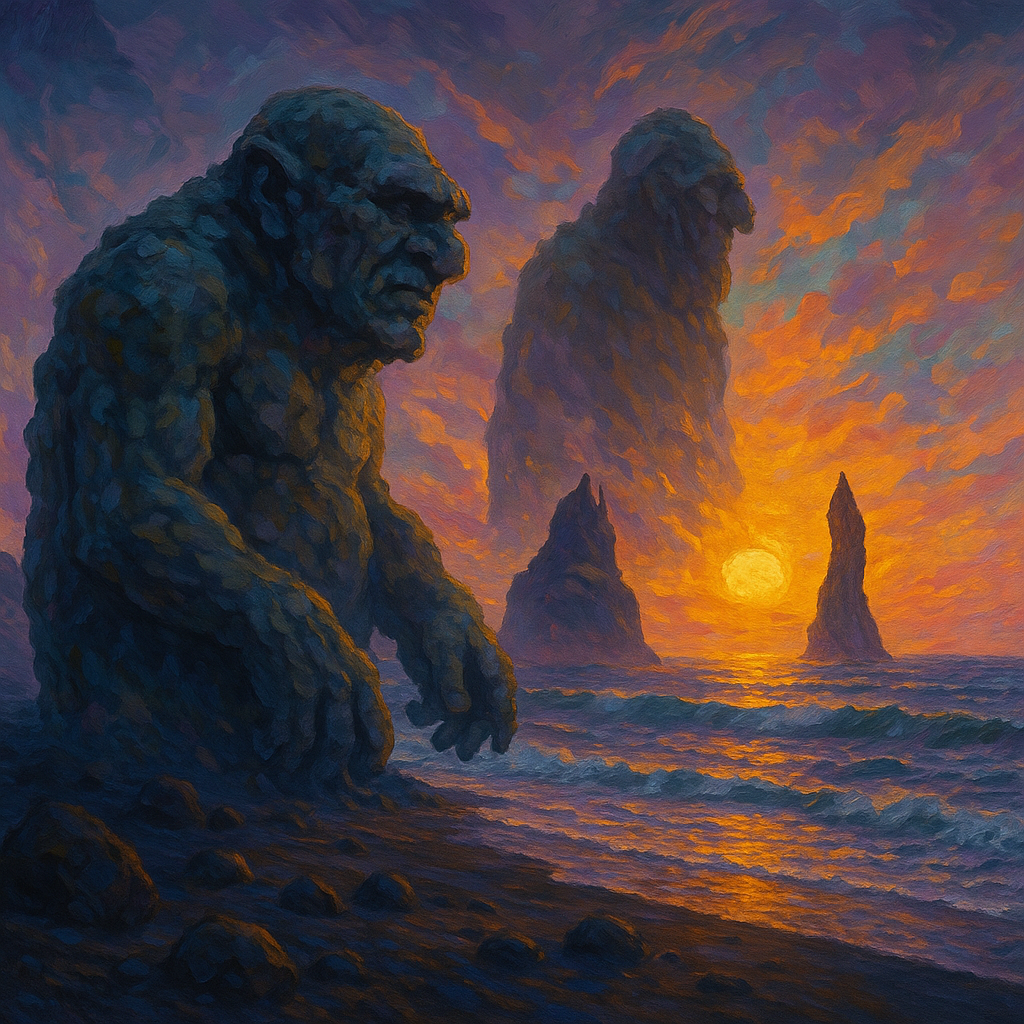
According to Icelandic folklore, trolls cannot survive the light of the sun. It is said that the sunlight reveals their true nature — chaotic, magical, and untamed — and hardens them instantly. In a frozen scream, their flesh stiffened, their muscles locked, and they were turned into stone. Their eyes, the legend says, remain wide and terrified, forever staring at the sea they tried to conquer.
The trolls’ petrification was not random: it was both a punishment for their greed and hubris and a reflection of nature’s dominance over chaotic forces. In essence, their transformation into stone serves as a cautionary tale: pride, recklessness, and disrespect for the natural world can lead to permanent consequences.
These petrified giants are known today as Reynisdrangar, the jagged basalt sea stacks just offshore from Reynisfjara. Towering up to 66 meters high, they remain one of Iceland’s most dramatic and mysterious natural landmarks. Locals often whisper that if the night is calm and the wind still, you can almost hear the trolls’ frustrated murmurs carried across the waves — a reminder that the story and the landscape are inseparable.
Historical Roots and Cultural Context
IIceland’s folklore is deeply intertwined with its harsh landscape and isolation. During the Viking Age and medieval period, oral storytelling flourished in remote farming communities where survival depended on reading nature’s signs. Trolls, elves, and spirits served as explanations for the unknown: sudden storms, shipwrecks, volcanic eruptions, and the eerily geometric basalt columns along the coastline.
Trolls were considered immense, nocturnal, and chaotic beings, living in caves or mountains, emerging only under the cover of darkness. Their vulnerability to sunlight is a recurring motif in Norse and Icelandic mythology, symbolizing the fragile balance between human ambition and nature’s uncontrollable forces. Sunlight acts almost like a natural law: it exposes truth, enforces order, and punishes chaos. In this way, trolls turning to stone is both magical and inevitable, as though the laws of the universe themselves enforce their fate.
Many Icelandic legends were eventually written down — notably in the 13th century — but the Reynisdrangar story survived mainly through oral tradition in the Vik area. Fishermen, farmers, and travelers told the tale to one another as both entertainment and caution: a reminder to respect the sea, the cliffs, and the unpredictable power of the land.
By the 19th century, with the rise of Romantic nationalism and growing interest in preserving local culture, scholars began documenting these legends. Yet, even today, the tale retains its folkloric quality, evolving with each retelling — still shared with children and visitors as a living story embedded in the landscape.
From Ancient Myth to Modern Memory
Today, Reynisfjara is more than a scenic beach — it is a cultural touchstone. The legend of the trolls has taken on new life in tourism, art, and local identity, linking Iceland’s ancient past to its present.
Here’s how it continues to live on:
Tourism and Guided Storytelling
Local guides incorporate the troll tale into their Reynisfjara tours. With dramatic narration, they point to the sea stacks and recount the myth to spellbound visitors. Some tours offer twilight beach walks, where stories are told by lantern light, blending nature, myth, and atmosphere. Visitors often pause to imagine the trolls mid-stride, reaching for treasure, frozen forever — a powerful visual lesson in the consequences of greed and pride.
Art and Sculpture
Several Icelandic artists have been inspired by the legend, creating paintings, sculptures, and installations depicting trolls caught in mid-motion, stone-grey and menacing yet tragic. Some artworks focus on the trolls’ human-like expressions, emphasizing emotion and narrative frozen in rock, while others highlight the stark contrast between the massive sea stacks and human visitors below, reinforcing the awe-inspiring scale of Icelandic nature.
Trolls in Modern Media
The Reynisfjara trolls have also appeared in global pop culture — from novels and graphic novels to documentaries and travel shows. Their mythic backstory often accompanies these appearances, reinforcing Iceland’s image as a land of living legend, where geological marvels and folklore intertwine.
Local Cuisine and Festivals
In recent years, the Vik region has embraced its folklore for culinary and festival inspiration. Restaurants offer dishes like “Troll’s Feast Stew,” made with wild herbs and lamb, evoking the rugged flavors of the Icelandic landscape. Local bakeries shape pastries like the sea stacks themselves or serve black licorice cookies dusted with gold, a playful nod to the trolls’ desire for treasure.
There’s even talk of a summer festival, Reynisdagur, blending local crafts, troll parades, and storytelling sessions for children. While not yet official, the concept reflects a growing interest in reclaiming myth as community heritage, linking past storytelling traditions to contemporary celebration.
Ecotourism with Mythic Flair
Sustainable tourism initiatives are pairing folklore with environmental awareness. Guided beach cleanups themed around “honoring the trolls” are growing in popularity. The message is clear: if the trolls are guardians of the shore, visitors must respect the land, sea, and ecosystems — blending mythic imagination with real-world action.
A Legend That Endures
The tale of the Reynisfjara trolls continues to inspire wonder and caution. It’s a reminder of the forces that shape both land and legend — and of how stories, like stone, endure across generations.
As Iceland modernizes, this myth, rooted in ancient fears, hopes, and moral lessons, becomes a bridge between past and present. Whether you are a folklore lover, a curious traveler, or a seeker of the strange, Reynisfjara offers not just a view, but a vision — a place where stone and story, greed and consequence, myth and landscape exist side by side.