Solar Sovereigns, Fertility Rites, and the Hidden Kingship of the North
Where Kings Ruled the Sun Itself
Long before Scandinavia was shaped by Christian monarchies and medieval crowns, there existed a form of kingship unlike any other — sacred, cyclical, and inseparable from the land itself. At the heart of this ancient system stood Uppsala, the spiritual and political center of pre-Christian Sweden, where kings were not merely rulers of men, but guardians of the sun, the harvest, and cosmic balance.
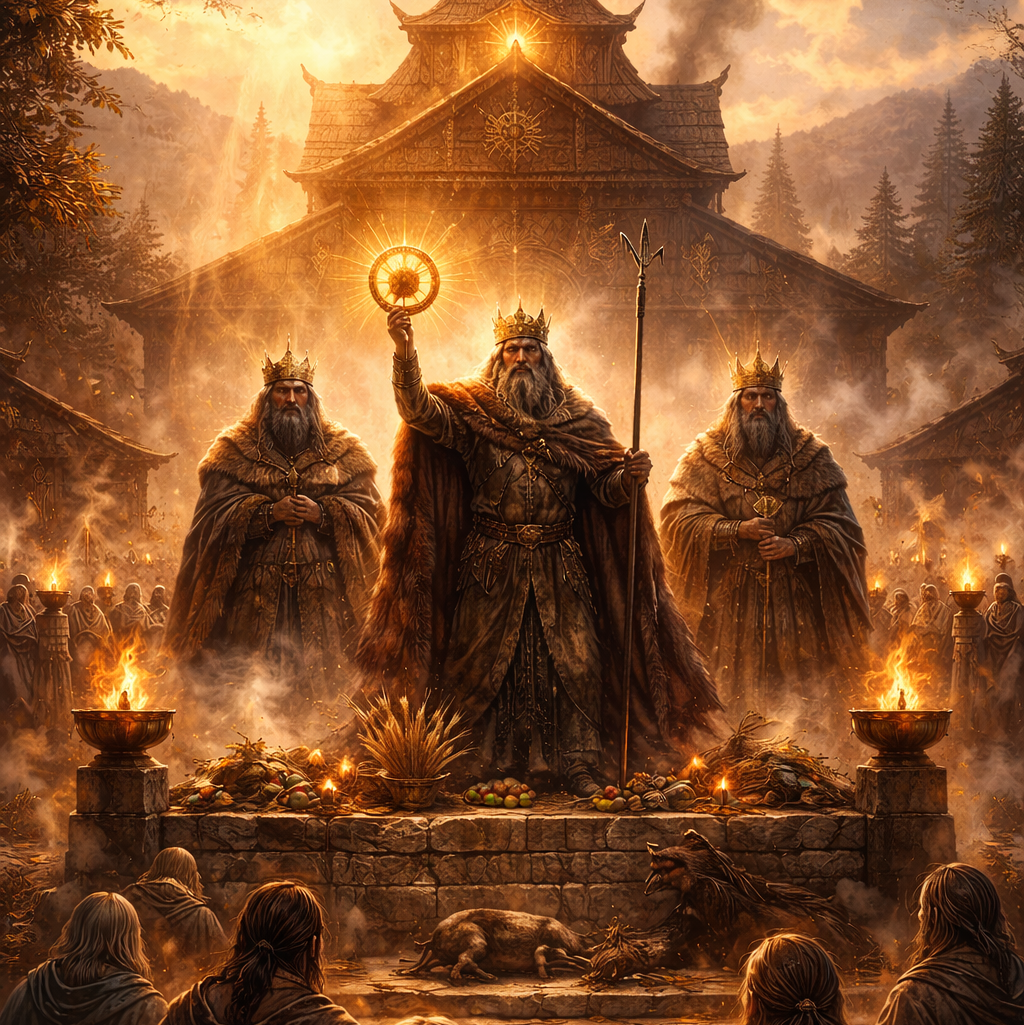
The Sacred Kings of Uppsala were believed to ensure the return of light after winter, the fertility of fields, and the survival of the people. Their power did not come from conquest, but from alignment with natural and solar cycles. When the land prospered, the king was blessed. When it failed, the king himself could be sacrificed.
This is not metaphor. It is documented belief. And fragments of it still survive today.
Uppsala: The Axis of the Northern World
Ancient Uppsala (Gamla Uppsala) was more than a settlement — it was a ritual landscape.
Archaeology confirms massive burial mounds, ceremonial halls, and a religious complex described by medieval chroniclers as the most sacred site in the North.
According to Adam of Bremen (11th century), Uppsala housed a grand temple dedicated to Odin, Thor, and Freyr — divinities directly tied to sovereignty, weather, fertility, and seasonal renewal. Freyr, in particular, was deeply associated with kingship and agriculture, and Swedish royal genealogies claimed direct descent from him.
To rule was to embody the divinitie’s favor.
Sacred Kingship and the Agricultural Cycle
The king’s role was profoundly ritualistic. He presided over blóts — seasonal sacrifices marking planting, harvest, and midwinter. These ceremonies were not symbolic alone; they were believed to actively influence cosmic forces.
If crops failed or winters grew harsh, the king’s legitimacy faltered. In extreme traditions preserved in later sagas, a king who brought famine could be ritually killed to restore balance — an idea echoed in broader Indo-European mythologies.
The king was not above the cycle. He was the cycle.
Solar Kings and the Return of Light
Midwinter was the most dangerous time of all. As darkness stretched endlessly across the North, the survival of both people and king hung in the balance.
The Sacred King was expected to ensure the return of the sun. His authority peaked during Yule, when fires, feasts, and offerings were made to strengthen the weakening light. This solar kingship connects Uppsala to a wider European tradition of seasonal rulers, where sovereignty rotated or was ritually renewed.
Here, kingship was not eternal. It was reborn.
From Pagan Kings to Christian Shadows
With the Christianization of Scandinavia in the 11th and 12th centuries, the temple at Uppsala was destroyed, and the old rites officially forbidden. Yet the transformation was not clean.
Elements of sacred kingship were absorbed rather than erased:
Royal coronations retained seasonal symbolism
Yule was reshaped into Christmas
Agricultural blessings continued under Christian saints
The solar king did not vanish — he changed masks.
Survival in Folklore and Modern Traditions
Today, the Sacred Kings of Uppsala survive in subtle but persistent ways:
Midwinter festivals in Sweden still center on light, fire, and communal renewal
Lucia processions echo solar symbolism through crowned figures of light
Place names, burial mounds, and local legends preserve memory of kingly sacrifice
Neo-pagan and historical reenactment communities actively revive Uppsala rites
Even modern environmental spirituality reflects ancient beliefs that leadership must serve land, balance, and cycles, not domination.
Why the Sacred Kings Still Matter
In an age of disconnected power and abstract authority, the Sacred Kings of Uppsala offer a radical alternative vision:
Leadership bound to responsibility. Power accountable to nature.
Their story invites reflection:
What would leadership look like if failure had real consequences?
What if prosperity demanded ritual care, not endless growth?
What cycles govern us now — unseen, unacknowledged?
The ancient kings may be gone, but the question they embodied remains unanswered.
Opening the Gate to Other Hidden Cycles
The Sacred Kings of Uppsala are not alone. Across Europe and beyond, legends speak of hidden sovereigns, liminal rulers, and cyclical kingship bound to thresholds of time.
To follow their trail is to step into a deeper map of myth — one still unfolding.